


Overview
The voice recorder system records flight-compartment area sounds, flight-crew radio/interphone communications, and Greenwich-Mean-Time (GMT) data, for safety and security reasons.
The voice recorder system can be monitored and tested from the flight compartment. Playback of the recorded data is done with a ground support equipment (GSE).
The primary component of the voice recorder system is the cockpit voice recorder (CVR). The CVR is a solid-state cockpit recorder (SSCVR). The SSCVR records continuously five inputs (time and four different audio-channel inputs).
The voice recorder system keeps recorded data during the last 120 minutes of operation.
The SSCVR changes the audio signals to a digital format signal and keeps the data in a solid-state memory.
The SSCVR system has a protection against crash and fire effects. The system has also a protection to prevent unwanted erase commands.
The voice recorder system has interfaces with the components/system that follow:
- Control Panel Electronic (CPE)
- Data Concentrator Unit (DCU)
- Panel Integral Lighting
12/23/15
Cockpit Voice Recorder (CVR)
The CVR is a line replaceable unit (LRU) located in the tailcone at FS760.00, on the LH. This LRU weighs approximately 9.9 lb (4.5 kg) and is installed in the CVR tray. The primary function of the CVR is to record audio and time data to a crash-survivable memory unit (CSMU). The memory installed in a crash and fire protection housing, gives two hours of continuous recording for each of the four audio channels and also for the time data channel.
The CVR has monitor, erase, and built-in test functions that are operator initiated from the CVR control panel, in the flight compartment. The erase function can operate only when it is enabled by two relays in the junction box No. 2. These relays are controlled by the proximity-sensor electronic unit (PSEU) and a parking brake switch.
An underwater locating device (ULD) is installed in front of the recorder. The ULD is a radio beacon that helps to find the CVR location in the event of a crash in water. The ULD has a water switch which, when closed, causes the ULD to transmit a radio signal. The ULD is also used as a CVR handle.
The CVR has a pin connector at the rear, for the aircraft interface. It also has a connector at the front, for the GSE replay equipment.
The CVR is energized by 28 VDC from the L ESSENTIAL BUS.


12/23/15
Recorder Independent Power Supply (RIPS)
On A/C Post SB350-23-009, the RIPS is installed between the CVR Tray and the CVR. It has a connector at the rear that connects the CVR interface connector. The pin connector at the rear of the CVR Tray connects the RIPS interface connector. The RIPS attaches to the mounting tray with two hold-down clamps. The CVR attaches to the RIPS with two hold-down clamps.
The RIPS powers the CVR, the Microphone Pre-amplifier and the area Microphone for 10 minutes±3 seconds after the aircraft power is removed.

12/23/15
CVR Tray
The CVR unit is installed in the CVR tray. This mounting tray weighs approximately 1.6 lb (0.7 kg). It has a pin connector at the rear that connects to the CVR aircraft interface connector. The CVR attaches to the mounting tray with two hold-down clamps.

11/28/16
CVR Control Panel
The CVR control panel is installed in the aft center pedestal, on the pilot's side. It attaches to the center pedestal with two captive screws. The control panel supplies the remote control functions for the CVR.
The CVR control panel includes a preamplifier used to increase the signal-to-noise ratio for the audio input from the remote area microphone.
At the front, the CVR control panels has the controls/functions that follow:
- A TEST switch (green) used to do the initiated built-in test (IBIT) of the CVR. When this switch is pushed for at least five seconds, it starts the IBIT test
- One light indicator (green ) associated with the TEST switch and used to show the IBIT test result. This component is a light emitting diode (LED)
- One HEADSET jack used to monitor the audio channels
- On A/C PRE IS100-23-0002, one ERASE switch (red) used to start the bulk erase of the recordings, when the aircraft is on the ground and the parking brake is set

Remote Area Microphone
The remote area microphone is installed in the glareshield center area. It is a directional microphone of electret condenser type. It collects for the CVR all the conversations, aural warnings, and sounds that occur in the flight compartment.
The audio signal from the remote area microphone is sent to the preamplifier installed in the CVR control panel.


08/23/16
CVR Impact Switch
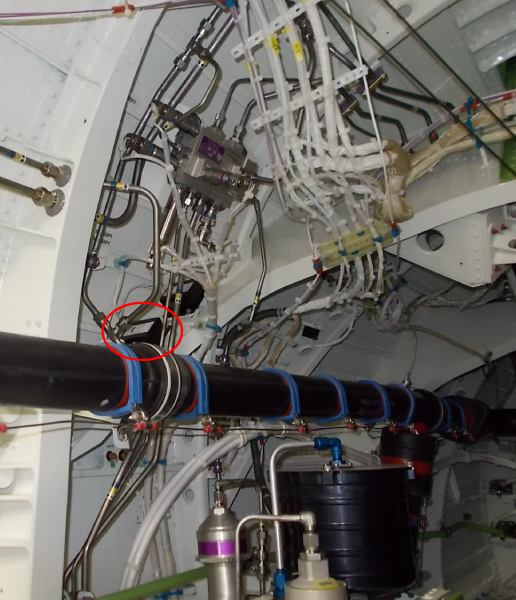
The CVR impact switch (S142) is an inertia type switch installed in the aft equipment compartment at FS781.00. The CVR switch is a sealed device that has two connectors and a reset pushbutton. This switch controls the power supply to the CVR. In normal conditions,
The impact force that occurs in a crash or hard landing (greater than 3 Gs) will cause the impact switch to open. This will remove the power supply to the CVR and prevent unwanted erasure of the CVR data.
The CVR impact switch will close again when the reset pushbutton is pushed.


CVR Underwater Locating Device (ULD)
The underwater locating device (ULD) is an LRU attached to the CSMU with two mounting brackets and four screws. The ULD contains an acoustic beacon, a battery, and a water switch.
When the water switch is wet, it closes to let the battery supply power to the ULD, which causes the ULD to send out a 37.5±1 kHz signal. The signal is transmitted for a minimum of 30 days at a range of 2,000 to 4,000 yd (1,828.80 to 3,657.60 m). The ULD is resistant to sea depths of 20,000 ft (6,096.00 m).
The battery is also a line-replaceable unit (LRU). It must be replaced before the date shown on the label on the ULD, is expired.

11/28/16
Operation
CVR Theory
The CVR records cockpit voice data and time in a solid-state memory that keeps data when power supply is removed from the system. The CVR functions and the high quality of recorded data is obtained with the SSCVR internal components that follow:
- One Aircraft Interface Unit
- One Audio Compressor
- One Acquisition Processor
- One Crash-Survivable Memory Unit (CSMU)
Aircraft Interface Unit
The aircraft interface unit changes the input electrical power (28 VDC) to secondary power for the CVR internal components. The aircraft interface also supplies 18 VDC to the CVR control panel. The regulated voltages are protected against short circuits.
The audio interface unit receives four audio inputs from the flight compartment audio channels and sends one audio output to the CVR control panel for the audio monitor signal. This audio interface unit supplies power regulation, lighting protection, RF attenuation, and discrete signal conditioning functions. The aircraft interface unit also supplies CVR status data to the data concentrator unit (DCU).
Audio Compressor
The audio compressor filters and encodes the audio signals. It adds the GMT time and sends the digital signal obtained (in a pulse code modulation [PCM] format) to the acquisition processor.
Acquisition Processor
The acquisition processor supplies logic power and process functions. In playback mode, this component transfers recorded data from the CSMU to the GSE, for digital to analog conversion.
The acquisition processor also supplies the built-in-test function for the voice recorder system.
Crash-Survivable Memory Unit
The crash-survivable memory unit (CSMU) is a solid-state, nonvolatile, high-capacity storage device that is contained in a strong protective housing.
This provides physical protection from the mechanical effects of a crash impact and also thermal protection from effects of a fire that can occur after the crash.
The solid-state memory is made of devices known as flash electrically programmable read-only memory (EPROM).
Each EPROM chip is a one megabyte device. The storage capacity of the memory is 120 minutes of continuous recording.
CVR Operating Modes
The CVR system can operate in the four modes that follow:
Record
The CVR records the four audio channel inputs that follow:
- Pilot (channel 3)
- Copilot (channel 2)
- 3rd crew member (channel 1) (optional)
- Flight-compartment remote area microphone (channel 4)
The audio inputs are then digitized, formatted, and compressed before they are kept in CVR memory.
Post SB 350-23-011, or Post SB 350-23-010
The Radio Interface Unit (RIU) provides all Datalink FANS exchanges between the aircraft and the ground control facilities (AFN, CPDLC and ADS-C). This feature is enabled via ground strap 'Datalink Valid' A129P1, pin 56 of the CVR.
The CVR system has a strap input. The strap input is a record jumper that enables the recording process to start as soon as power is connected to the system.
Monitor
You can monitor the mixed audio of the four channels during recording with a headphone connected to the phone jack (HEADSET) on the CVR control panel. This audio monitor channel is also used to listen to the aural test tone of 600 Hz during an initiated self-test of the CVR.
Erase (On A/C PRE IS100-23-0002)
The erase function removes all the recorded data from the CVR memory. The ERASE C discrete signal is sent from the SSCVR to the erase relays.
When the weight-on-wheels (WOW) and the brake park lock signals are present, the relays are energized and the erase signal is sent to the CVR control panel. If the ERASE switch on the CVR control panel is pushed, the signal is returned to the SSCVR on the ERASE A line. In these conditions, all the SSCVR recorded data is erased.
Self-Test
You can start an initiated built-in test (IBIT) of the CVR with the TEST pushbutton on the CVR control panel. The TEST switch must be pushed for at least five seconds to supply the push-to-test discrete signal to the CVR.
If the IBIT test is satisfactory, a status discrete output from the CVR is set to the CVR control panel. This causes the light of the indicator on the CVR control panel, to come on (green light). A 600 Hz tone can also be heard through the HEADSET jack on the CVR control panel.
If the IBIT test is unsatisfactory, no indication is given at the CVR control panel.
The audio inputs are tested with the insertion of a 600 Hz tone on each input channel. The tone is detected by the self-test circuit and reported through the test indicator.
The recorder also does continuously other background built-in tests. The results of these tests together with the operator initiated tests give a status signal (CVR VALID) that the SCVR sends to the DCU.
09/05/18
System Interface
The voice recorder system has interfaces with the components/systems that follow:
Control Panel Electronics
The channel four input of the CVR receives its audio input directly from the CVR control panel. The other channels receive their audio input through the control panel electronics (CPE) units.
A CVR amplifier in each CPE unit adds all voice, warning tones, and navigation aurals from different sources.
Audio inputs from the pilot's station are sent to CVR channel three input through the CPE No. 1.
Audio inputs from the copilot's station are sent to CVR channel two input through the CPE No. 2.
Audio inputs from the observer's station are sent to CVR channel one input through the CPE No. 3. There is a third CPE when the observer third audio system option is installed.
Data Concentrator Unit
The CVR system meets the time synchronization requirements. GMT time reference is supplied to the CVR on a low speed ARINC 429 bus (A-DCU-4) by the aircraft clock system, through the DCU.
The status data of the CVR sent to the DCU supplies the EICAS.
Radio Interface Unit (RIU) No. 1
Post SB 350-23-011, or Post SB 350-23-010
Datalink FANS messages are provided by RIU No. 1 via ARINC 429 bus (L-RIU-CVR). The FANS message recording feature is enabled via ground strap 'Datalink Valid' P1, pin 56 of the CVR.
Erase Interlock Relays
Two erase interlock relays for the CVR are installed in junction box No. 2. These relays prevent the erase mode operation in flight. They are energized to close the contacts for the erase discrete signal (ERASE C) to go through, when the aircraft is on the ground and the parking brake is set.
The park-brake enable relay is controlled by the PSEU. The WOW enable relay is controlled by a switch in the brake control system.
Power Supply
On A/C 20501 to 20739 Pre SB 350-31-004
The CVR system is energized by L ESSENTIAL BUS through the CVR circuit breaker on CB1-D6, and the CVR impact switch. When a crash occurs, the CVR impact switch opens to remove 28 VDC power from the SSCVR.
On A/C 20740 and Subs and On A/C 20501 to 20739 Post SB 350-31-004
The CVR system is energized by R ESSENTIAL BUS through the CVR circuit breaker on CB2-D7, and the CVR impact switch. When a crash occurs, the CVR impact switch opens to remove 28 VDC power from the SSCVR.
Integral Lighting
The CVR control panel receives 5 VDC power from the integral lighting system.
01/28/16
System Monitoring
Messages Display
The CVR FAIL advisory message will show on the EICAS when the CVR senses an internal fault.
The EICAS message that follows is related to the voice recorder system:
| EICAS MESSAGE(S) | LEVEL (COLOR) |
|---|---|
| CVR FAIL | ADVISORY (cyan) |
Note:
When the Recorder IndependenThe EICAS message that follows is related to the voice recorder system:t Power Supply (RIPS) is installed, CVR system shows the health status of RIPS.
CVR FAIL Advisory CAS message displays for a maximum of 10 minutes in the following conditions:
- After each A/C power up
- After CVR CB reset
- Immediately after RIPS operation, when the power to CVR is recovered.
- In flight, when the temperature of the insulated RIPS battery reaches 0 °C.
During above conditions the CVR continues to record. When the CVR FAIL message shown, no CVR test indication and no headset sound heard at the control unit. The indication and sound is heard, when the CVR FAIL message not shown.

10/15/20
Component Location Index
| Component Location Index | |||
|---|---|---|---|
| IDENT | DESCRIPTION | LOCATION | IPC REF |
| A129 | COCKPIT VOICE RECORDER (CVR) | ZONE(S) 310 | 23-71-01 |
| - | COCKPIT VOICE RECORDER (CVR) TRAY | ZONE(S) 310 | 23-71-05 |
| PL30 | COCKPIT VOICE RECORDER (CVR) CONTROL PANEL |
ZONE(S) 211 | 23-71-09 |
| - | REMOTE AREA MICROPHONE | ZONE(S) 211 | 23-71-13 |
| S142 | COCKPIT VOICE RECORDER (CVR) IMPACT SWITCH |
ZONE(S) 310 | 23-71-17 |
| - | COCKPIT VOICE RECORDER (CVR) UNDERWATER LOCATING DEVICE (ULD) |
ZONE(S) 310 | 23-71-21 |
| A229 | RECORDER INDEPENDENT POWER SUPPLY (RIPS) (POST SB 350-23-009) |
ZONE(S) 310 | 23-71-25 |