

01/18/16
Overview
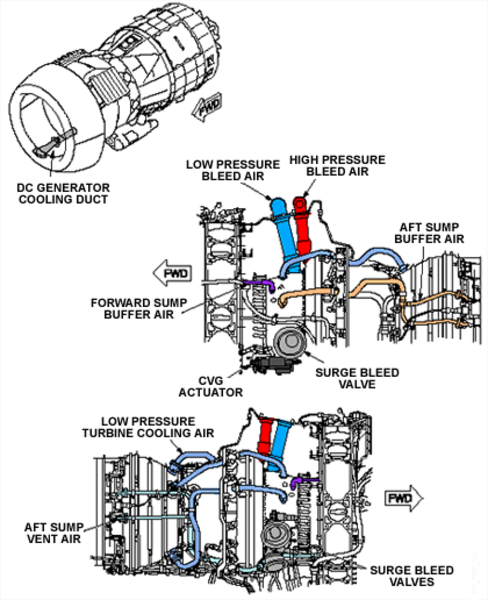
The air system consists of all external units, components and integral basic engine parts that allow airflow to various portions of the engine and engine driven accessories.
The air system is a multifunction system and has provisions for:
- Engine turbine cooling
- Engine buffer air supply
- Aircraft accessory cooling
- Aircraft pneumatic air supply
- Engine compressor surge control
In the lower speed range, during acceleration and decrease of power, it is possible for the engine to surge. This is because the airflow through the high pressure (HP) compressor is not as stable as during usual continuous operation. The air system makes sure that the compressor operates smoothly during its full speed range with the control of the compressor input air and bleed air.
The air system controls the input air to the compressor with a fuel-pressure control system. The air system can also bleed air from the compressor to help control the compressor operation. The air system receives the necessary control inputs from the full-authority digital engine-control (FADEC) system.
The engine bleed air system provides compressed air to the environmental control system (ECS). Secondary functions include wing and nacelle anti-ice and engine start.
The engine bleed air system is comprised of low pressure (LP) and high pressure (HP) supply ducts which are fed from tapping points at the 12 o'clock position on the engine above the rear of the LP/HP compressor section
The HP duct provides high pressure bleed air to the wing and engine inlet anti-ice systems. A high pressure shutoff valve is located downstream of the bleed air source to control airflow to the wing anti-ice system. The nacelle inlet anti-ice system has an anti-ice shutoff valve located under the upper engine cowling. The HP bleed air ducts are joined together under the engine cowling.
The engine efficiency is improved and the risk of mechanical damage is reduced with the supply of hot air from the HP bleed port. Bleed air from the HP compressor is used to cool the blades and the vanes of the turbines and the engine bearing sumps. This keeps engine efficiency at the same level and reduces the risk of mechanichal damage. Bleed air is also used to pressurize the sump seals and the buffer cavities. Also, the air system uses intake air to cool the generators.
The Engine Air system interfaces with the following systems:
- Fuel control system
- Full authority digital engine control (FADEC) system
- Pneumatic system