


Overview
The emergency locator system automatically transmits a radio signal when there is a crash which closes the impact switch.
11/06/15
Emergency Locator Transmitter
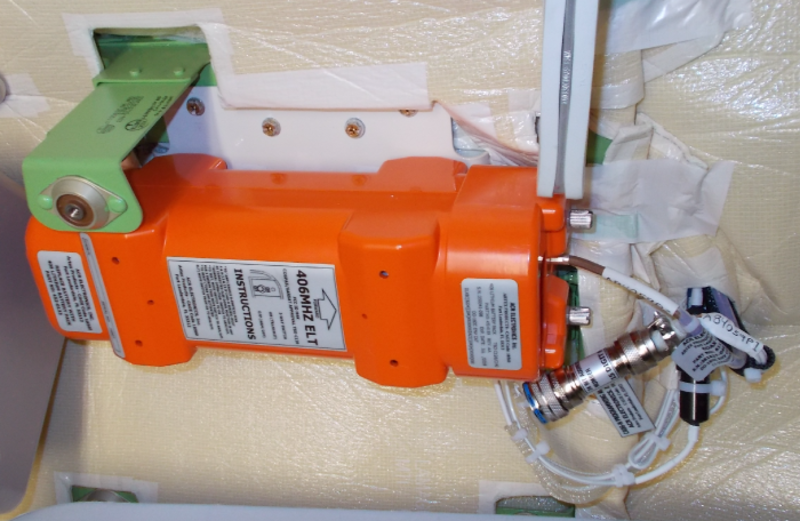
The Emergency Locator Transmitter (ELT) is a radio that transmits a signal to help search and rescue operations. The ELT transmits on a frequency of 121.5 MHz (VHF) and 243.0 MHz (UHF) up to 48 hours at -20 °C (-4 °F). It also transmits a digital code on 406.025 MHz for aircraft identification to satellite for 24 hours only at -20 °C (-4 °F). The ELT is installed in the top left side of the aft fuselage (between stringer 4 and 5) between FS653.00 and FS664.25.
When the ELT is activated the signals are transmitted until the battery pack loses power (minimum of 48 hours) or the system is reset. The battery pack is internal to the ELT and it supplies electrical power to the antenna and the remote control. The ELT has a 3-position switch, ARM, OFF and ON. The ON position is for a system test or to manually turn on the ELT. The ARM position is for the usual function. The OFF position turns the ELT completely off.
The ELT has an internal impact switch which operates the ELT automatically when the G-force is more than 2G. The ELT also has a red LED that comes on when the ELT transmits.
The built-in battery, in normal conditions, has to be changed at regular intervals as per the Time Limits/Maintenance Checks (TLMC) manual.

Emergency Locator Antenna
The emergency locator antenna sends the emergency signal when the system is on. It is connected to the ELT and is found on top of the aft fuselage at FS643.90.

Emergency Locator Buzzer
The buzzer is found in the aft equipment compartment, under the walkway, aft of the aft equipment-compartment door. It is installed on a bracket attached to the frame at FS788.53. The buzzer operates when the ELT transmits.

Emergency Locator Transmitter Panel
The ELT panel is on the aft center pedestal in the flight compartment. The pilot/copilot can operate the ELT from the ELT panel.
The ELT panel has a 3-position switch, ON, ARM and RESET. The ON position will send an emergency signal from the ELT. It is also used for a system test. The ARM position is for the usual function. To reset the system after a test or in case of an accidental operation, momentarily put the switch to RESET. A spring in the switch will automatically move the switch back to the ARM position.


11/06/15
Operation
When the ELT and the ELT panel switches are in the ARM position, the ELT will transmit automatically when there is a crash above 2G. If the G-force is not sufficient to start the ELT, the pilot can put the ELT control panel switch to the ON position to start the transmitter.
The emergency locator buzzer will operate and the ELT ON status message will show when the ELT transmits.
The EICAS message that follows is related to the emergency locator system:
| EICAS MESSAGES | LEVEL (COLOR) |
|---|---|
| ELT ON | STATUS (white) |
Note:
A search and rescue operation can start if you are not careful when you work on the emergency locator system. You must do the emergency locator system test only during the first 5 minutes of every hour (UTC time). You must not keep the ELT switch or ELT panel switch to ON for more than 3 seconds.
You must make sure the ELT does not transmit when set to OFF or when the ELT panel switch set to RESET. If it continues to transmit, disconnect the antenna cable from the ELT and contact air traffic control personnel. The ELT switch is set to ARM which is a mandatory state during flight. This switch should be selected just after an ELT installation. If you follow the above training information points you will prevent the start of an emergency situation.

10/29/20