


12/29/15
Overview
The air data probes and sensors of the aircraft have heaters. They do not let ice collect on the air data probes and sensors. The air data sensor heater current monitor controls and monitors the electrical current supplied to heaters found in the probes and sensors. It controls and monitors the current to the following components:
- Left and right pitot static probes (base and probe)
- Standby pitot probe
- Left and right static ports
- Left and right angle-of-attack (AOA) sensors (case and vane)
- Total air temperature (TAT) probe
The function of the pitot and static anti-icing system is to prevent ice to collect on the air data probes, ports and angle-of-attack (AOA) sensors.
Note:
Although they are not part of the pitot and static anti-icing system, the AOA sensors are mentioned in this section because the heater elements that are in them are controlled by the same components (the air-data-sensor heater-current monitors) than the air data probes and ports. The AOA sensors are part of the stall protection system (SPS).

Air Data Sensor Heater Current Monitor
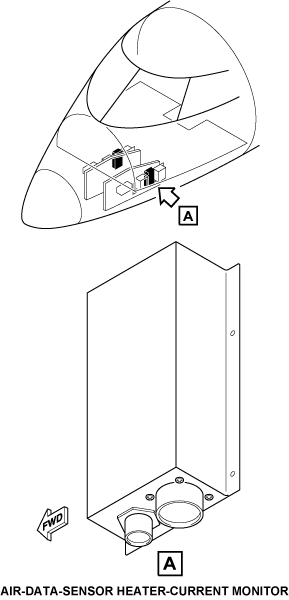
There are two air data sensor heater current monitors on the aircraft. They are installed in the forward lower nose compartment at FS280.00.
One current monitor is installed on the left side at BL 8.00 and the other on the right side at BL 8.00. The two current monitors are the same, and they have the capacity to control and monitor six channels each. These channels are controlled independently. If a probe or sensor heater does not operate, the air data sensor heater current monitor gives indications to the flight crew on the engine indicating and crew alerting system (EICAS).
The left current monitor controls and monitors the following probes and sensors:
- Left pitot static base
- Left pitot static probe
- Standby pitot probe
- Left static port
- Left AOA sensor case
- Left AOA sensor vane
The right current monitor controls and monitors the following probes and sensors:
- Right pitot static base
- Right pitot static probe
- TAT probe
- Right static port
- Right AOA sensor case
- Right AOA sensor vane
The left air data sensor heater current monitor receives 28 VDC power from the L ESS BUS.
The right air data sensor heater current monitor receives 28 VDC power from the R ESS BUS.




03/30/22
Operation
The current monitors have a programmable logic device (PLD). This device controls and monitors the heater function, does self-tests, controls the discrete outputs and reads the discrete inputs.
The current monitor controls the power supplied to the heater elements depending of the input signal (on or off) from the pushbutton annunciators (PBAs) on the ANTI-ICE control panel. The current monitor monitors individually the heater current when the PROBES L and PROBES R PBAs are set on.
One or two heater elements are found in each probes, ports and sensors. The pitot-static probes have one element in the base and one in the probe. The AOA sensors have one element in the case and one in the vane. The other probes, ports and sensors have one element only.


Controls and Displays
The electrical current supplied to the heaters is controlled on or off with the PROBES L and PROBES R PBAs of the ANTI-ICE control panel. The PBAs have OFF written on them and their light is white. When the PBAs are pushed in (PBA light goes off), the system is set to on and the current monitor puts the input signal to the ground.
Usually, the system operates in this condition. When the PBAs are not pushed in (PBA light comes on), the current monitor removes the ground from the input signal. In this condition, the system is fully off and the heaters do not operate.
When the PROBES L (R) PBA is pushed, electrical current goes from the high side of an air data probe heater element, through the element to the low side. It then goes into the air data sensor heater current monitor and back out of the air data sensor heater current monitor to ground. The ground path is opened when the air data sensor heater current monitor removes power to the heaters. The heater elements in the air data probes are internally controlled (meaning more current draw is necessary when the temperature is low). The air data sensor heater current monitor does not supply more control to the heater elements other than to set heater power on.
The current for each heater channel is monitored to make sure that the heater operates correctly. If the electrical current through the heater element decreases, the heater may not prevent ice buildup on the related probe. An EICAS message fault shows, which tells the flight crew that data received from this sensor can be incorrect. The flight crew can then remove power from the right or left side sensors with the PROBES L and PROBES R PBAs of the ANTIICE control panel. This sends a signal to the related air data sensor heater current monitor which removes the ground.
TAT Interface
All the probes, ports, and sensors are controlled on or off by the PBAs. The TAT probe is also controlled by the TAT WOW relay. The PSEU controls the relay when it senses the weight-on-wheels (WOW) signal. The relay removes power from the TAT probe when the signal from the PSEU is received. When this occurs, the current monitor senses that there is a failure of the TAT heater. However, no failure is shown to the flight crew because it is inhibited by the DCU since there is no failure with the heater.


12/29/15
System Interface
The pitot and static anti-icing system has interfaces with the following systems/components:
- Stall protection system (SPS)
- Anti-ice control panel
- Engine indicating and crew alerting system (EICAS)
The air data probes and sensors system has interfaces with the following components/systems:
- Angle-of-attack sensor
- Anti-ice control panel
- Engine indicating and crew alerting system (EICAS)
- Systems test control panel
- Proximity-sensor electronic unit (PSEU)
- Pitot-static and temperature system
System Monitoring
The air data sensor heater current monitors keep track of the current to make sure it does not decrease quickly because of a fault. If a fault occurs, the current monitor goes to a failsafe condition (where power is applied to all heater channels). In usual operation, the current monitor does a continuous built-in test (CBIT) of itself. In a reset condition, after power-up or a power interruption, the current monitor does a power-up BIT (PBIT).
CBIT
The CBIT does a check of the multiplexers, analog to digital (A/D) converter, and programmable logic device (PLD) using set test voltages to the multiplexers. The PLD identifies the set test voltages to the multiplexers during all cycles it reads from the A/D converters. This test does make sure that operation of the current sensing circuitry is correct. System failures occur if the test fails.
PBIT
A reset mode starts immediately after power-up or a power interruption of a set period of time. This mode is a PBIT test sequence. The PBIT puts a known current to the current monitor circuits before heater power starts. The test makes sure that all the functions in the air data sensor heater current monitor operate correctly except the discrete outputs.
System Test
A test can be done with the SYSTEMS TEST control panel. When the rotary switch is set to PROBES and pushed, it starts the pilot-initiated test (PIT). The primary function of PIT is to make sure that all the discrete status outputs operate correctly because none of the other types of BIT check the outputs.
When the PIT is started, the PLD changes all outputs from the correct condition to a fail condition and then back to the correct condition.
During the test, no EICAS messages that indicate a failure must display. At the end of the test, an EICAS message shows that the test is completed and correct.
The remote data concentrator (RDC) makes sure that this test sequence occurs. The air data sensor heater current monitor gives system failure status to the RDC. This data is then sent to the data concentrator unit (DCU) which gives the EICAS messages.
