

Overview
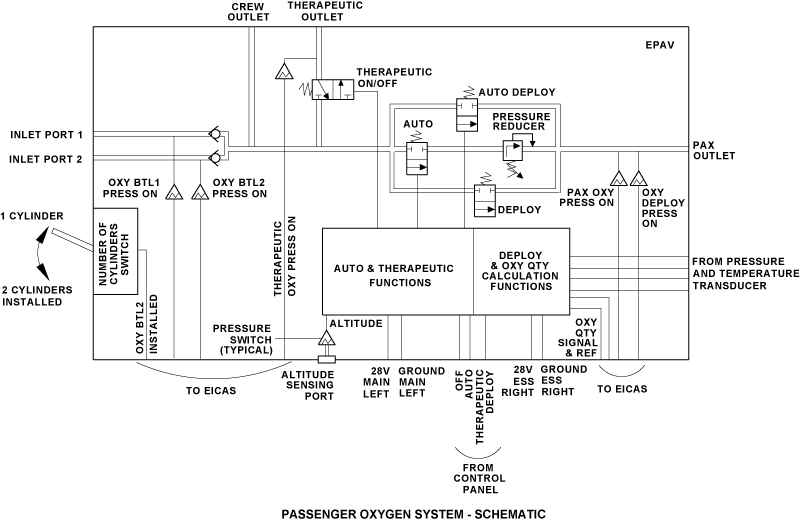
The passenger system receives oxygen from the same cylinder(s) as the crew oxygen system. Control for the passenger system is from the OXYGEN control panel. Before the oxygen goes to the passenger compartment, it goes through an electro pneumatic actuating valve (EPAV). The EPAV controls the oxygen outlet pressure to the passenger circuit.
The passenger oxygen system supplies oxygen to the passengers if there is a cabin low pressure or other emergency. Oxygen is supplied from the electro pneumatic actuating valve (EPAV) to the passenger circuit by low-pressure lines. The passenger circuit is controlled by valves in the EPAV. These valves can isolate the passenger and crew circuits, if necessary, through the selection of OFF on the OXYGEN control panel. The passenger oxygen system has interfaces with the oxygen pressure/temperature transducer.

Oxygen Control Panel
The OXYGEN control panel is in the center pedestal. It has a pushbutton annunciator (PBA) labeled THERAPEUTIC with a guard used to set oxygen for therapeutic use. It shows a white ON legend when the therapeutic oxygen circuit is on. There is also a three-position rotary switch (OFF, PAX AUTO, and DEPLOY positions). The rotary switch has a detent that requires it to be pulled and turned to set it to the OFF position (from PAX AUTO) and to the AUTO position (from OFF). The control panel sends outputs to the EPAV through electrical wires.


Electro Pneumatic Actuating Valve
The electro pneumatic actuating valve (EPAV) is in the oxygen cylinder compartment in the lavatory section on the right side of the aircraft. It attaches to the aircraft structure above the oxygen cylinders. EPAV controls the supply of oxygen for the passenger oxygen system and gives system data to the crew members through the engine indicating and crew alerting system (EICAS). EPAV receives ambient temperature data and oxygen cylinder pressure from the pressure/temperature transducer. EPAV calculates this data and supplies an analog signal of the cylinder pressure to the EICAS.
EPAV has two pressure switches for each inlet supply circuit. The pressure switches indicate if the line is pressurized or not. This data is supplied to the EICAS. There are three other pressure switches to supply the status of therapeutic and passenger circuits. Electrical power is necessary for EPAV to supply passenger and therapeutic circuits. Power is supplied to EPAV from the L MAIN BUS (for AUTO and therapeutic modes) and the R ESS BUS (for DEPLOY mode). It is not necessary to have electrical power to supply the crew circuit. Crew and passenger circuits are fully isolated. This is to ensure oxygen necessary for the flight crew is available at all times.
Two inlet ports supply EPAV with oxygen from the cylinder(s). One inlet is sealed if only one cylinder is available. The toggle switch on the lower right side of EPAV is for selection of the number of oxygen cylinders in the aircraft. The three outlets supply the crew members, therapeutic needs, and passenger circuits. A test port is available to simulate cabin altitude for test functions. All these pneumatic connections on the EPAV have a different type and dimension of connector. This is to prevent the risk of incorrect connections.

12/03/15
System Operation
The OXYGEN control panel gives commands to EPAV for therapeutic and passenger circuits to supply the functions as follows:
- Control and adjust the oxygen outlet pressure for the passenger circuit based on aircraft altitude (AUTO mode)
- Supply the passenger circuit when there is decreased pressure in the oxygen cylinder (DEPLOY mode)
- Give supplied pressure to the crew members circuit
- When necessary, supply low pressure from the cylinder to the therapeutic circuit
When the switch is OFF, an electrical signal to the EPAV turns off the passenger oxygen circuit.
The OXYGEN VALVE CLOSED caution message shows when the oxygen cylinder shutoff valves (SOVs) are closed.
The PAX OXYGEN AUTO FAIL caution message shows when an error occurs in the AUTO mode of operation. This message tells the pilots that the rotary switch on the OXYGEN control panel must be set to DEPLOY. This message does not show if the rotary switch is set to OFF or if cabin altitude is below 15,000 ft (4,572 m).
The PAX OXYGEN OFF status message shows when the rotary switch is set to OFF.
The PAX OXYGEN ON status message shows when the aircraft is on the ground and the oxygen supply pressure is on. The status message also shows when the aircraft is in flight with the oxygen supply pressure on and the passenger masks are deployed. This message does not show if the rotary switch is set to OFF.
The EICAS messages that follow are related to the passenger oxygen system:
| EICAS MESSAGE(S) | LEVEL (COLOR) |
|---|---|
| OXYGEN VALVE CLOSED | CAUTION (amber) |
| PAX OXYGEN AUTO FAIL | CAUTION (amber) |
| PAX OXYGEN OFF | STATUS (white) |
| PAX OXYGEN ON | STATUS (white) |
Modes of Operation
The two applicable modes of operation are AUTO and DEPLOY.
The L MAIN BUS supplies power for the AUTO mode and therapeutic selection. The R ESS BUS supplies power for the DEPLOY mode and for oxygen quantity calculation. The AUTO and DEPLOY modes are isolated to ensure oxygen is supplied to the passengers if there is a power supply fault condition.
Auto
Usual operation is in the AUTO mode. EPAV controls the automatic supply of the passenger masks. Oxygen is supplied to the passenger masks when the cabin pressure altitude is 14,500 ± 500 ft (4,420 ± 152 m). Oxygen flow to the masks stops automatically when the cabin altitude falls below 9,500 ± 500 ft (2,896 ± 152 m).
The therapeutic selection controls the supply of oxygen to therapeutic masks when connected to therapeutic couplings. When this selection is made, the AUTO mode stays on.
Deploy
DEPLOY mode controls the deployment of passenger masks and supplies oxygen to the masks at all cabin altitudes. This mode is used if the AUTO mode has a fault condition.
The EICAS shows the oxygen quantity available on the summary page and on the ECS synoptic page.