

08/23/24
Message Overview:
Message Name:
UNCOMMANDED AIRCRAFT ROLL IN FLIGHT CAUSED BY SPECIFIC FLAP SETTING
| Message Code: | 275OBS001 |
| Effectivity: | All |
| System: | Flap System |
| System Description: | 27-52-00 - Flap System |
| Schematic Diagram: | None |
| Wiring Diagram: | None |
Message Description:
During flight, a specific flap setting can generate un-commanded aircraft roll. The roll is usually noted when the pilot is hand flying the aircraft. In some cases, aircraft may start rolling few seconds after the Flap position is adjusted.
Possible Causes:
- Flap rigging
- Multi-function spoiler and/or ground spoiler Teflon stop pad missing
- Teflon protective coating on the upper surface of flap
- Incorrect installation of FWD and/or AFT flaps fairing and seal
- Incorrect installation of access panel
Troubleshooting Tips:
Advisory Wire/Service Bulletin:
- AW300-57-0112 - Flap Roll Caused By Paint Disturbances
Forum Articles/Infoservice/Newsletter: None
Flight Operation Notifications Manual (FONM): None
NOTES:
- Paint ridges on the flap
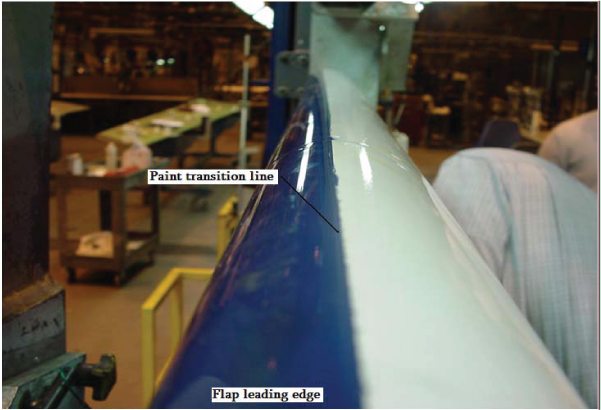
- The most critical location for a paint ridges is at the flap leading edge. Uncommanded aircraft roll due to paint ridge on the flap is usually felt when the flap are extended. It is possible to have an aircraft roll increased with the flaps sets at higher angles.
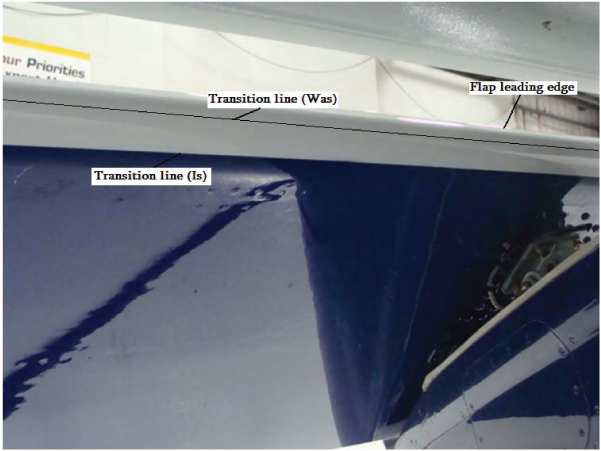
- Bicolor flaps can significantly increase the chance of getting this condition. Also a flap with rough finishing surface or a bad paint touch up can lead to the same result.
- Isolate a wing section with an abnormal airflow
- At safe speed and altitude, extend the flight spoilers to ¼.
- Set the flap to the angle that causes the aircraft to roll and look for any significant roll change.
- If the roll is still present, pay particular attention at the forward section and the leading edge of the wing.
- If the roll is no longer present, inspect flaps and spoilers.
- For detailed inspection, follow the troubleshooting recommendation.
Quick Links:
| Electrical/Electronic Safety Precautions | AMM 24-00-00-910-801 |
| Electrostatic-Discharge Safety Precautions | AMM 24-00-00-910-802 |
| Connect Electrical Power to the Aircraft | AMM 24-00-00-861-801 |
| Rigging of the Flap Control Surface | AMM 27-52-21-820-801 |
| Rigging Check of the Flap Control Surface | AMM 27-52-21-220-801 |
| Removal of the Multi-Function Spoiler Shim Pad | AMM 27-62-05-000-802 |
| Installation of the Multi-Function Spoiler Shim Pad | AMM 27-62-05-400-802 |
| Removal of the Ground-Spoiler Shim Pad | AMM 27-63-09-000-802 |
| Installation of the Ground-Spoiler Shim Pad | AMM 27-63-09-400-802 |
Troubleshooting Recommendations:
- Clean up both flaps surfaces.
- Perform a visual inspection of both flaps and wings, look for a flap surface deformation, dent or kink (Leading edge, trailing edge).
- If deformation, dent or kink are found, repair or replace as required and do close out.
- If deformation, dent or kink are not found, continue with next step.
- Perform a visual inspection of both flaps and wings for paint ridges especially at the flap trailing edge and leading edge.
- If there is no paint ridges on the flap, go to step 5.
- If there is paint ridges on the flap, continue with next step.
- For the paint ridges for the single color flap, sand and buff the paint ridges until the paint transition is not noticeable. Refer to the SRM manual for the topcoat thickness limits (Make sure you do not abrade to base material). The surface finish has to be smooth and continuous to minimize the impact on the airflow. For the paint ridges for the bicolor flap, we suggest to move the paint transition-line to the lower surface of the flap in order to have only one color around the leading edge. & 2 below)
- Perform a visual inspection of both flaps and wings for a repaired section.
- If there is repaired section, the repaired section topcoat must be smooth and continuous. Any defect found in this area must be rectified as required and do close out.
- If there is no repaired section, continue with next step.
- Perform a visual inspection of both flaps and wings for a damaged Teflon protective coating on upper surface of flap.
- If any Teflon protective coating are are missing on the surface of the flap, causing ridgeline or roughness, repair as required and do close out.
- If no Teflon protective coating are missing on the the surface of the flap, continue with next step.
- Perform a visual inspection to verify smoothness of wing sealant.
- If wing sealant are rough, smooth the required area and do close out.
- If wing sealant are smooth, continue with next step.
- Inspect wing leading edge for abnormal condition or bent parts.
- If there is abnormal condition or bent parts, repair or replace as required and do close out.
- If there is no abnormal condition or bent parts, continue with next step.
- Inspect under multi-function spoiler & ground spoiler for missing Teflon stop pad.
- If Teflon stop pad is damaged or missing, repair or replace as required and do close out.
- If Teflon stop pad is no damaged or missing, continue with next step.
- Perform the rigging check of the Flap control surface.
- Do close out.