

01/23/25
Message Overview:
| DDG Reference: | 36-10-01 |
| Pilot Action (QRH): | ENVR 06-5 |
| System Description: | 21-51-00 - Filtering and Flow Control System 30-11-00 - Anti-Ice System |
| Schematic Diagram: | SSM 36-21-00-101 - Bleed-Air Leak-Detection System PACK LOOP SCHEMATIC |
| Wiring Diagram: | WM 36-21-11-1_001 - Sheet 1 - Pack Loop - ALL |
Message Description:
A red 'PACK LEAK' (Warning) Crew Alerting System (CAS) message indicates a leak has been detected in the air conditioning pack ducting.
- The Integrated Air System Controller (IASC) has detected a bleed air leak around the pack inlet from the pack inlet detection loops. Through ARINC bus to the Data Concentrator Unit (DCU) the Engine Indication and Crew Alerting System (EICAS) has displayed the red PACK LEAK warning CAS message
- The Pack bleed loop is a Dual Loop System
Possible Causes:
- Left Bleed Loop Sensor 1 (MT67)
- Right Bleed Loop Sensor 1 (MT38)
- Right Bleed Loop Sensor 2 (MT40)
- Right Bleed Loop Sensor 3 (MT71)
- Pack Loop Sensor 1 Channel A (MT73)
- Pack Loop Sensor 1 Channel B (MT141)
- Associated Wiring
Troubleshooting Tips:
Advisory Wire/Service Bulletin:
- AW300-30-0354 - Potential Piccolo Tube Damage When Replacing a Bleed Loop Element
- AW300-36-0387 - Bleed Air Leak Detection Loop Elements
Full Throttle Blog/Forum Articles/Infoservice/Newsletter: None
Flight Operation Notifications Manual (FONM): None
NOTES:
- Troubleshooting Guide for Bleed Loops
- Bleed air loops are the detection element used to indicate that a leak has occurred in the bleed air system.
- The ducting has a insulation cover that will contain the air leaking from the ducting routing it to a insulation vent hole
- The loop elements are electrically connected in series and the concentric outer conductor is connected to the aircraft ground. The layer of eutectic salt compound insulates the outer conductor from the inner conductor. When hot bleed-air gets on the loop element, the eutectic salt compound becomes conductive and lets the outer conductor make contact with the inner conductor. The IAS controller senses that the outer conductor is grounded and supplies the inner conductor with alternating current for its resistance measurement. The IAS controller measures this resistance and shows the correct message on the EICAS
- There are two loops along each line, IASC 1 channel B monitors Pack Loop A. IASC 2 channel B monitors Pack Loop B
- The intermediate pressure system loop element senses a bleed-air leak when the temperature is more than 255°F (123.90°C)
Quick Links:
| Component Location | AMM 36-21-00-992-801 |
| Operational Test of the Bleed-Air Leak-Detection and Warning System | AMM 36-21-00-710-801 |
| Resistance Check of the Bleed-Air Leak-Detection Loops | AMM 36-21-00-760-801 |
| Removal of the Left Bleed-Loop Element | AMM 36-21-01-000-801 |
| Installation of the Left Bleed-Loop Element | AMM 36-21-01-400-801 |
| Removal of the Pack-Inlet Leak-Detection Element | AMM 36-21-11-000-801 |
| Installation of the Pack-Inlet Leak-Detection Element | AMM 36-21-11-400-801 |
| Safety Precautions - Maintenance Practices - ALL | SPM 20-00-01-02 |
| Wire Repair - Maintenance Practices - ALL | SPM 20-12-10-02 |
| Electrical Connectors - Description and Operation - ALL | SPM 20-20-00-00 |
Troubleshooting Recommendations:
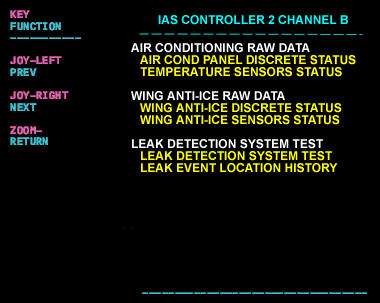
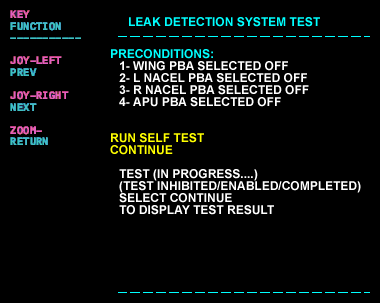
Going into the system diagnostics to the IASC 1 channel B (Pack A fault) or IASC 2 channel B (Pack B fault) to display the IASC Channel B menu. The IASC LRU test page will provide pages to perform a leak detection system test and check past event locations.
- Locate the short circuit or leak using the Leak Event location function.
- Check for short circuit at the corresponding connector.
- Check the loop routing for a fouling condition on a hot surface (loop touching duct).
NOTE: Before replacing a loop always look at the loop for routing, ensure loop is not too close to the plumbing or the bleed hole on a valve. Review AMM 36-21-00-992-801 for component location. See individual loops for specific routing information. - Use a Tegam meter to check capacitance and inductance between the inner and outer conductor of the corresponding loop. Perform the impedance check per the Leak detection how to.
Leak Event Location History
The Leak Event Location History will identify when the system posted a fault, what loop failed and a general location based on an approximate fuselage/wing station location of the overheat condition.
The CH350 reports the name of the bleed loop and fuselage station or wing station and general location of the leak in percentage. A 0% location starts at the beginning of the loop and the end of the loop is 100% so a 5% indication will be 5% of the total loop length.
PACK LEAK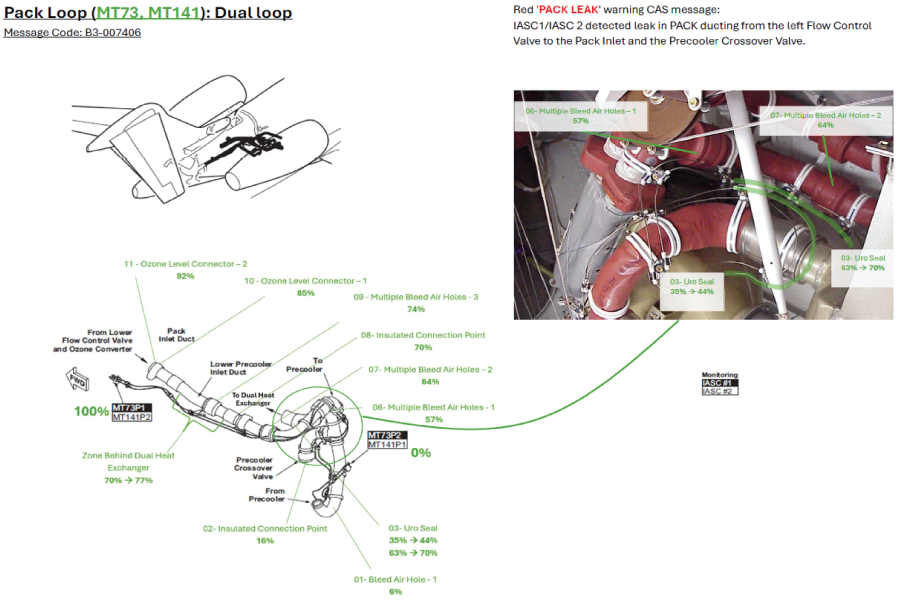
- When a location is identified in the leak event location history, Inspect the plumbing for possible leaks
- If the leak can not be identified, perform the system functional check IAW AMM 36-21-00-710-801
Leak Detection Test
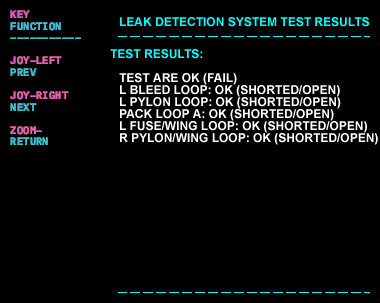
- The test will check all of the loops the IASC is monitoring and pass or fail them. This test may fail if there is a lot of action going on in the IASC, retesting may pass the failed loops. This test is disabled with the wing heat system on.
- The test will identify if the pack loop has a short or open (> 26 Ω). Perform resistance checks on the applicable loop per AMM 36-21-00-760-801.
- Select the associated MDC Fault message:
- Do close out.
| LOOP | VALUE (OHMS) |
|---|---|
| Pack | 26 Ω |