


05/06/21
Message Overview:
Message Description:
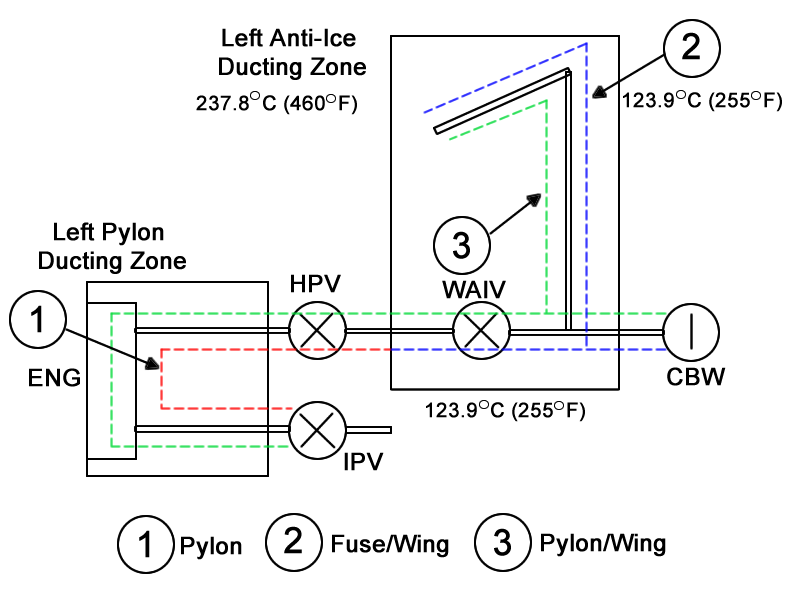
The LEFT PYLON LOOP is detected shorted to ground by the IASC-1 during the system self-test. Check the loop and wiring isolation to ground.
Possible Causes:
- L Pylon Loop 1A (MT63)
- Associated Wiring
Troubleshooting Tips:
Advisory Wire/Service Bulletin: None
Forum Articles/Infoservice/Newsletter: None
Bleed Loop routing and visual aid guide
Troubleshooting Guide for Bleed Loops
NOTE: If the bleed loop resistance value is within limits try cleaning the bleed loop connections per SPM 51-25-00-110-801 and then reapply lubrication to the connections per SPM 20-20-00. Lubrication part number is called out in each bleed loop installation procedure. Run the aircraft after the cleaning and applying lubing procedure and see if the BLEED LOOP FAULT clears.
Quick Links:
| Operational Test of the Bleed-Air Leak-Detection and Warning System | AMM 36-21-00-710-801 |
| Initiation Test of the Bleed-Air Leak-Detection Loops | AMM 36-21-00-740-801 |
| Resistance Check of the Bleed-Air Leak-Detection Loops | AMM 36-21-00-760-801 |
| Bleed-Air Leak-Detection System - Component Location | AMM 36-21-00-992-801 |
| Removal of the Left Pylon-Loop Element | AMM 36-21-05-000-801 |
| Installation of the Left Pylon-Loop Element | AMM 36-21-05-400-801 |
| Removal of the Left Pylon Anti-Ice Leak-Detection Element | AMM 36-21-05-000-802 |
| Installation of the Left Pylon Anti-Ice Leak-Detection Element | AMM 36-21-05-400-802 |
| FENWAL SAFETY SYSTEMS | CMM 26-14-47 |
| Solvent Cleaning | SPM 51-25-00-110-801 |
| Wiring - Maintenance Practices - ALL | SPM 20-12-00-02 |
| Wire Repair - Maintenance Practices - ALL | SPM 20-12-10-02 |
| Electrical Connectors - Maintenance Practice - ALL | SPM 20-20-00-02 |
Troubleshooting Recommendations:
- Gain access to IASC #1 through the LH aft nose kidney panel 141BL.
- Disconnect connector A56P4 from the IASC and check resistance between pins 17 and 18. Resistance should be approximately 3.2 ohms.
- Isolate a system short through standard practices by isolating the loop and wiring from the IASC. Repair faulty wire segment or replace loop as required.
L PYLON LOOP Schematic and resistance values
NOTE: Measure Insulation resistance and line resistance of the detection loops as per the Leak Detection Elements troubleshooting sheet. Make sure line resistance & insulation values are within the specified limits.
NOTE: Often while troubleshooting this discrepancy the CAS is not usually present. However what you may find is higher than normal resistance such as 10 ohms or higher above nominal. It is not high enough to trip a bleed loop fault CAS message but high enough to assist in troubleshooting. When you get the resistance value down to nominal values then it is safe to say you've corrected the discrepancy.

