

01/22/25
Message Overview:
Message Name:
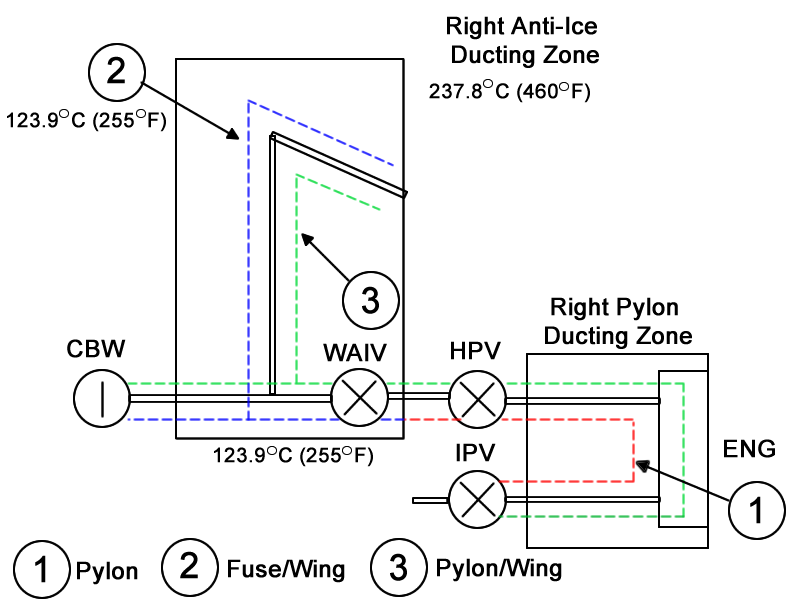
R PYL/FUS/WING DUCT LEAK
Message Code:
B3-007866
| Reporting LRU: | Dual Loop System |
| Associated CAS: | WING ANTI-ICE LEAK (Warning) |
| System Description: | 30-12-00 - Wing Anti-Ice System 36-20-00 - Indicating System |
| Schematic Diagram: | SSM 36-21-00-101 - Bleed-Air Leak-Detection System |
| Wiring Diagram: | WM 36-21-13-1_001 - Sheet 1 - Left Anti-Ice Fuselage Loop - ALL WM 36-21-15-1_001 - Sheet 1 - Right Anti-Ice Fuselage Loop - ALL |
Message Description:
This message will be displayed when one loop in a Dual Loop System detects an overheat for more than five minutes.
Possible Causes:
- Bleed Loop Routing
- Right Wing Anti-Ice (R WAI)/Fuse Loop Sensor 1 Channel B (MT46)
- Right Wing Anti-Ice (R WAI)/Fuse Loop Sensor 2 Channel B (MT48)
- Right Wing Anti-Ice (R WAI)/Fuse Loop Sensor 3 Channel B (MT50)
- Right Wing Anti-Ice (R WAI)/Fuse Loop Sensor 4 Channel B (MT52)
- Right Wing Anti-Ice (R WAI)/Fuse Loop Sensor 5 Channel B (MT104)
- Right Wing Anti-Ice (R WAI)/Fuse Loop Sensor 6 Channel B (MT120)
- Dirty Wing Tip Connections at Bleed Loops
- Associated Wiring
Troubleshooting Tips:
Advisory Wire/Service Bulletin: None
- AW300-36-0008 - "WING ANTI-ICE LEAK" EICAS Message During Climb
Full Throttle Blog/Forum Articles/Infoservice/Newsletter: None
Flight Operation Notifications Manual (FONM): None
NOTES:
Quick Links:
| Operational Test of the Wing Anti-Ice System | AMM 30-10-00-710-801 |
| Component Location | AMM 36-21-00-992-801 |
| Operational Test of the Bleed-Air Leak-Detection and Warning System | AMM 36-21-00-710-801 |
| Initiation Test of the Bleed-Air Leak-Detection Loops | AMM 36-21-00-740-801 |
| Resistance Check of the Bleed-Air Leak-Detection Loops | AMM 36-21-00-760-801 |
| Removal of the Wing-Root Leak-Detection Element | AMM 36-21-17-000-801 |
| Installation of the Wing-Root Leak-Detection Element | AMM 36-21-17-400-801 |
| Removal of the Wing-Middle Leak-Detection Element | AMM 36-21-17-000-802 |
| Installation of the Wing-Middle Leak-Detection Element | AMM 36-21-17-400-802 |
| Removal of the Wing-Outboard Leak-Detection Element | AMM 36-21-17-000-803 |
| Installation of the Wing-Outboard Leak-Detection Element | AMM 36-21-17-400-803 |
| Safety Precautions - Maintenance Practices - ALL | SPM 20-00-01-02 |
| Wiring - Maintenance Practices - ALL | SPM 20-12-00-02 |
| Wire Repair - Maintenance Practices - ALL | SPM 20-12-10-02 |
| Electrical Connectors - Maintenance Practice - ALL | SPM 20-20-00-02 |
Troubleshooting Recommendations:
- Interrogate the Leak Event Location on both IASC 1 and IASC 2 channel B with the Maintenance Diagnostic Computer to determine the exact location of the leak.
WING ANTI-ICE LEAK (B3-007866)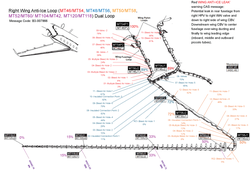
- Once the percentage value is obtained from the MDC, refer to mapping tool representing all potential bleed leak locations in term of percentage, for each metered bleed air hole and LRU connections point. This will help to quickly troubleshoot source of the leak.
- Check for short circuit at the corresponding connector.
NOTE: Before replacing a loop always look at the loop for routing, ensure loop is not too close to the plumbing or the bleed hole on a valve. Review AMM 36-21-00-992-801 for component location. See individual loops for specific routing information. - Use a Tegam meter to check capacitance and inductance between the inner and outer conductor of the corresponding loop. Perform the impedance check per the Leak Detection How To.
- Replace affected loops that do not pass.
- Do close out.