


04/28/16
Overview
The static discharge system is installed to keep concentration of static electricity to a minimum. Unusual static discharge causes radio receiver interference. This interference is caused by corona discharge given out from the aircraft surfaces (because of precipitation static and movement in the aircraft). Precipitation static occurs when the aircraft hits charged air or moisture particles. Static electricity usually goes out at the wing and tail ends. The static dischargers release the static at points where there is little or no coupling of the static into the radio receiver antennas.
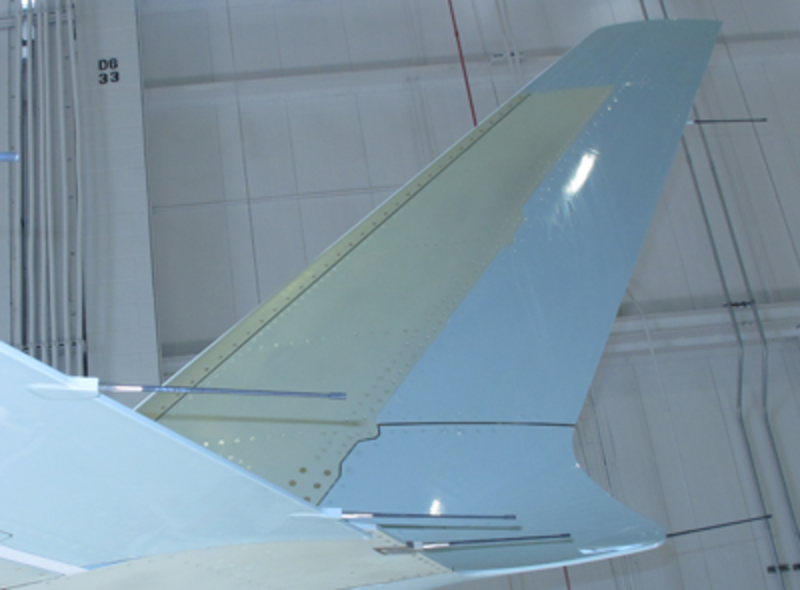
The static discharge system consists of a group of static dischargers bonded to the aircraft's wings and tail. They are installed on the trailing edges of winglets/wing, vertical stabilizer, horizontal stabilizer, elevators, rudder, ailerons, and tail cone. The dischargers allow gradual bleed-off of static from the airframe to prevent radio interference. These dischargers release static electricity into the air to decrease radio interference. There are three types of static dischargers installed on the aircraft.
The static dischargers on the winglets have internal threads on their mounting ends. The static dischargers on the wing, tail cone, and vertical stabilizer have external threads on their mounting ends. The static dischargers on the rudder, elevators, and horizontal stabilizer attach to their base with setscrews.
All dischargers attach to mounting bases which are bonded to the aircraft structure. The external thread type is a screw-on-base type. The internal thread type is attached by a screw to the base and the screw is sealed. The base is electrically bonded to the aircraft structure/surface and sealed.

04/28/16
Static Discharger
Each static discharger assembly has two parts: the static discharger and the mounting base. The static discharger can be replaced without removal of its base. The discharger base is part of the aircraft structure.
The discharger is a resistive slender graphite-coated rod of aligned fibers, tapered towards the tip. This design supplies flexibility and graded resistance, which has a noise-quieting quality. Mounting threads are found at the other end of the discharger. The mounting end of the internal thread type is tapered to fit into the discharger base. The discharger also has a heat-shrunk sheath for more protection. The discharger tip is a small brush that is made up of 700 nichrome wires to give a high-current capability at a very low threshold potential.
Static discharger type 2-1 7SC-1 has external threads on its mounting end. The remaining types have internal threads on their mounting ends. All dischargers are threaded into mounting bases, which are bonded to the aircraft structure. External thread type is a direct screw-on base-type. A screw attaches the internal thread type to the base type and the screw is sealed.
Static Discharger Base
Two types of bases are installed: The standard type (Chelton 2-23), and the machined fitting type. All discharger bases are made of titanium material except the ones at WS 530, which are made of aluminum. The dischargers are electrically bonded to the aircraft structure/surfaces and sealed. The contact resistance between the bases and airframe must be less than 0.1Ω.

System Operation
Flight through precipitation, electric cross-fields and engine-produced ionization build up electrostatic charges on the aircraft. Streamer currents on the plastic frontal area of an aircraft during precipitation encounters, and corona discharge between airframe members also generate RF noise. While the aircraft is flying between speeds of 120 to 600 knots, these charges can generate radio frequency noise, which disrupts reception on communication and navigation systems operating between 0 and 1,000 MHz.
Aircraft Charging
Aircraft charging occurs as an airplane flies through freezing rain, ice crystals, dust, sand or snow. Aircraft flying in clear air beneath a cloud layer can also acquire a positive or negative charge on the airframe. The magnitude is a function of the potential of the cloud with reference to ground and the charge. As the aircraft charge builds, a potential is reached where the charge leaks off the aircraft and antennas, generating broadband radio frequency noise. This interferes with ADF, HF, as well as VHF and VOR receivers.
Streamering
Radio noise is also generated by streamer currents on the plastic frontal area of an aircraft during precipitation, and corona discharge between airframe members.
Streamering is generated over insulated surfaces such as a radomes, fiberglass winglets and other fiberglass panels positioned on frontal impact areas of the aircraft. As particles strike, they deposit electrons on the insulated surfaces. As more particles reach this isolated pool, the voltage increases until it reaches the flashover point. When the pool of charge flashes over the surface of the insulated material, it generates broadband radio frequency noise.
This phenomenon is also observed over metal surfaces painted with a high-strength dielectric paint, which forms insulating material over the aluminum skin. In this case, charges accumulating on the paint generate streamers to a rivet head or screw fastener. Coating the non-conductive surface with a high-resistance paint can solve streamering noise. Such paint bleeds charged particles quietly off to the aircraft fuselage.
Corona Noise
Corona noise occurs when the aircraft accumulates sufficient charge to ionize air around wing tips, vertical and horizontal stabilizers and other protrusions. As current bleeds off trailing edges, it generates radio frequencies that sound like loud hissing on aircraft receivers. The same charging can also cause antennas to go into corona (bleeding-off of the charge). When this bleeding off occurs through the antenna it can appear like a strong signal to the receiver. The squelch circuits then cause a large decrease in receiver sensitivity effectively shutting down the receiver.
Static dischargers installed in strategic places, i.e. wing tips, winglets, vertical and horizontal stabilizers, bleed off this charge quietly and prevent corona discharge.
Note:
Streamering and corona currents primarily affect ADF and HF frequencies. They tend to decrease in intensity at VHF and higher frequencies.
Arcing Noise
Improperly bonded metallic objects cause this interference. This condition causes charges to build until arcing occurs between structures. This arcing can produce broadband noise extending through 1,000 MHz. Grounding straps between structures will remedy this problem. This condition can be isolated using electrostatic test equipment.
System Test
Testing the static dischargers consists of a visual inspection and resistance checks. The visual check is carried out to check for missing, broken or loose dischargers and to check for any lightning damage.
There are two resistance checks required to test the static dischargers, which are a discharger resistance check and a discharger base to aircraft bonding check. The discharger resistance test is carried out using a megohm meter and the bonding check is carried out using a milliohm meter.
09/04/20
Component Location Index
| Component Location Index | |||
|---|---|---|---|
| IDENT | DESCRIPTION | LOCATION | IPC REF |
| - | STATIC DISCHARGER (WITH EXTERNAL THREADS) | ZONE(S) 320, 346, 542, 642, 587, 687 | 23-61-01 [ GX ] [ GXRS ] [ G5000 ] |
| - | STATIC DISCHARGER (WITH INTERNAL THREADS) | ZONE(S) 551/651 | 23-61-01 [ GX ] [ GXRS ] [ G5000 ] |
| - | STATIC DISCHARGER (WITH SETSCREWS) | ZONE(S) 347, 353/363, 354/364 | 23-61-01 [ GX ] [ GXRS ] [ G5000 ] |