

05/25/16
Overview
The auxiliary power unit (APU) is located in the tail cone of the aircraft behind the rear pressure bulkhead. It is mounted on a canted bulkhead attached to the vertical stabilizer rear spar and is enclosed in a fire-resistant compartment .
The primary component of the airborne auxiliary-power system is the APU. The APU is installed on the mounting struts in the tail of the aircraft. The APU is a gas turbine engine which starts with aircraft or ground DC power, and operates on fuel supplied to the aircraft. It has two modules, the power section and the gearbox. The APU has five basic modes of operation, each of which has a related load condition:
- At idle (at full speed and has no shaft or bleed load, but is prepared for a load)
- For engine starts (has a bleed load)
- For environmental control (has a bleed load)
- For auxiliary ac power (has a shaft load)
- With a shaft load and a bleed load at the same time
The APU fitted to the Global Express is a Honeywell gas turbine engine, Model RE220, equipped with a Lucas electrical generator. The RE220 APU is a single shaft engine, designed to function as a self-contained source of pneumatic and electric power and may be used while airborne or on the ground, within certain limitations. Electrical power may be extracted from the APU in the form of shaft horsepower that drives the APU generator, which may be used to feed the aircraft electrical power system. The APU's electrical loads take priority over pneumatic loads. The air system prevents a surge when APU operates the APU generator at altitudes more than 8,000 ft (2,440 m).
Pneumatic power may be extracted from the APU both in flight and on the ground, as compressed bleed air for the airplane's ECS and MES (i.e., Environmental Control Systems and Main Engine Starting, respectively). APU bleed air is not available for anti-icing.
The main components of the RE220 engine are a centrifugal compressor, a combustor, a two-stage axial turbine, an exhaust system, an accessory gearbox and an integral oil system with a built-in reservoir. The engine is provided with a monopole and a pair of thermocouples to enable measurements of RPM and EGT respectively, for display in the cockpit.
The APU compartment is completely sealed from the atmosphere except for an air inlet door, an exhaust duct and a few other smaller outlet ports. Fire protection for the APU is provided by detection elements, and extinguisher plumbing located around the APU. In addition, the APU is designed for full rotor burst containment.
Access to the APU for inspection, maintenance and servicing is provided by two cowl doors which are hinged to the left and right sides of the fuselage, and are fastened together at their bottom ends to maintain the airtight integrity of the APU's enclosure.
These doors are to be kept closed during normal APU runs; however, they may be open for:
- A maximum of 10 minutes for inspection during APU runs with no loads imposed on it; or
- A maximum of 5 minutes loaded for inspection during APU runs - APU bleed air on and a maximum electrical load of 20 kVA
If these limits are not followed, the APU oil temperature may exceed operating limits due to insufficient cooling air across the oil cooler. If the oil temperature of the APU is exceeded, the APU will carry out an auto shutdown.
The function of the airborne auxiliary-power system is to supply the alternative sources of power which follow:
- Pneumatic power for the bleed air system
- Shaft power to make AC power
The APU provides bleed air for cabin cooling and heating through the environmental control system (ECS), main engine starting (MES), and electrical power on the ground and in flight.
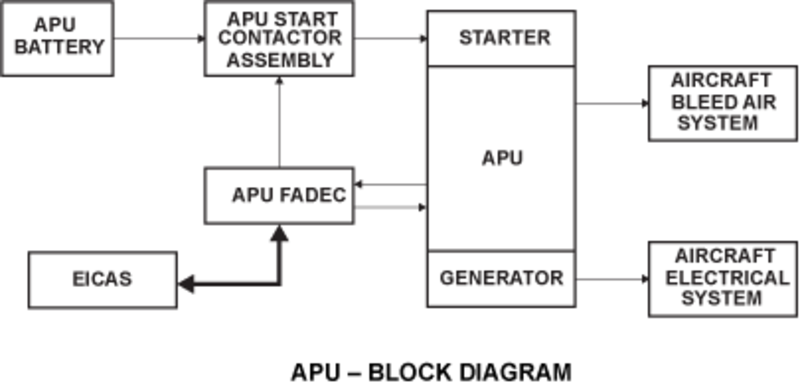
The main component of the APU electrical system is the electronic control unit (ECU), also known as the full authority digital engine control (FADEC). The APU FADEC interfaces with EICAS and the central aircraft information maintenance system (CAIMS), providing failure detection and isolation of faulty components.
Control of APU speed is automatic and monitoring of APU exhaust gas temperature (EGT), speed, fuel and oil pressure is through the FADEC. The FADEC also records operating hours and start cycles. The engine speed for normal continuous steady state is displayed as 100% rpm. Overspeed protection is provided. The APU has automatic shutdown for abnormal ground and in-flight conditions.
APU start and run is initiated by a single switch, located on the APU control panel in the flight compartment. APU electric and bleed system operation is monitored at the ELECTRICAL and BLEED/ANTI-ICE synoptic pages respectively. The APU is capable of operating up to 45,000 feet while supplying electrical power with operating limitations. The APU starting envelope is up to 37,000 feet, and can supply bleed air for ECS and MES up to 30,000 feet.