


Overview
The optional mini Quick Access Recorder (QAR) is a non-crash survivable digital data recorder that is installed in addition to the Flight Data Recorder (FDR).
Its intent is to provide a means for making FDR data more easily available in terms of download operation, storage capacity, accessibility, for health, maintenance or flight data monitoring purposes.
This system supports JAROPS 1.037 required Flight Data Monitoring System among other applications.
The following provide QAR installation information:
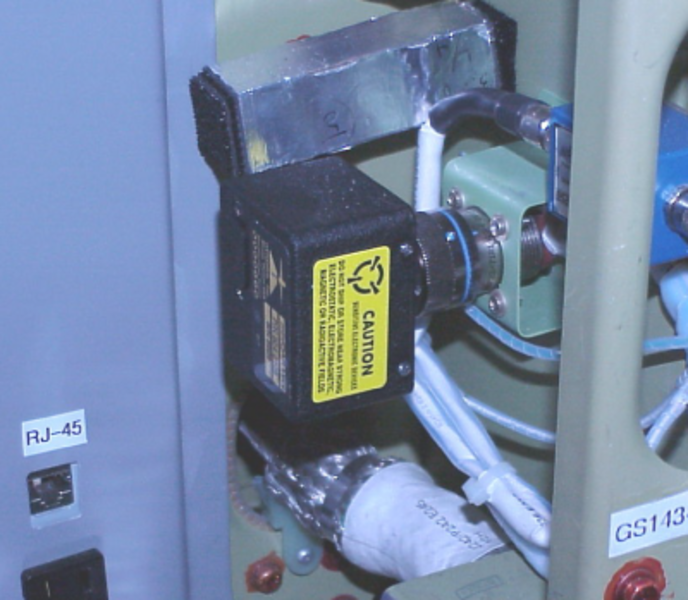
Quick Access Recorder
The primary function of the QAR is to acquire ARINC 717 data from Data Acquisition Unit (DAU 4B) output and record it to a 1 GB internal memory.
The recording duration depends on the input data rate: with a 128 words per second (WPS) rate, the unit is thus capable of saving up to 1,480 hours of flight data, or 740 hours with a rate of 256 WPS.
Stored data can then be downloaded from the memory for analysis on a ground station using specific data analysis software tools. Note that the data mapping is same as the FDR since it is provided by the DAU 4B.
The QAR is installed on the forward side of the FS280 bulkhead near the floor behind the copilot seat.

Data Acquisition Unit No. 4
DAU 4 receives normal acceleration analog data from the dedicated 3-axis high-G accelerometer and SSFDR status from the SSFDR. DAU 4 provides data to FDR and the QAR at the rate of 128 words per second via ARINC 717 data bus. With SB 700-31-020 incorporated, the DAU 4 rate has been increased to 256 words per second.
System Operation
Normal operation of the QAR does not require any action from the crew.
The avionics system provides Harvard bi-phase ARINC 717 format from DAU4B at a rate of 128 words per second or 256 words per second. When receiving valid ARINC 717 data, the QAR detects the rate automatically, and starts recording. Correct recording operation is indicated by the extinguished front panel LED. Should improper or no data be received by the QAR, the LED would illuminate. Recording automatically stops when data stream stops. When the memory is full, the front panel LED indicator will blink, and the data recording is stopped.
The QAR does not provide any indication on its operational status to other aircraft system, and therefore does not interface with the crew alerting system nor the centralized maintenance system.
QAR Data Download
The QAR may be downloaded while installed in the aircraft, or can be removed from the aircraft and taken to a ground station for data retrieval and analysis.
In both cases, the download is done through the front connector using USB2.0 protocol with a cable connected to a laptop or desktop computer with the Avionica mQAR MkII high speed USB download software installed. The part number of the Avionica download kit, which contains the software and the cable, is 805-0005.
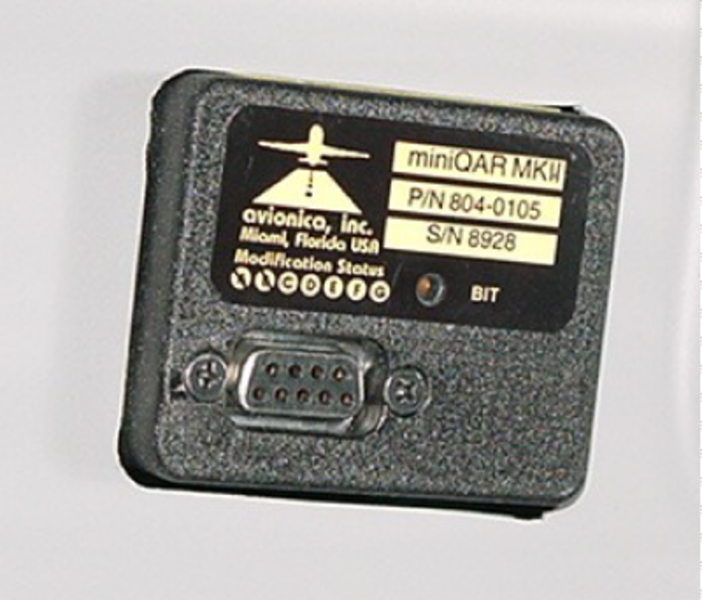
The download software provides tools to:
- Retrieve data from the QAR memory
- Process the data and convert it to a *.TSC file (12 bit packed) readily useable by any analysis software (Note: this format matches the Standard Flight Data Recorder format for Honeywell ADRAS software)
- Erase the data on the QAR memory
Once downloaded and processed into the right format, the retrieved data is readily available for analysis using separate data analysis software tools.
System Interface
Signal Interface
The aircraft interface required for the QAR is an ARINC 717 input line with FDR data. The QAR data input lines are derived from the ARINC 717 line that goes from the DAU 4B to the FDR.
Power Inputs
The QAR unit is a DC device that nominally draws 1 Watt of power. It is powered in parallel via JB6 with FDR on the SPDA-2 28 VDC BUS 2. Thus, the QAR shares the FDR system circuit breaker.

System Test
QAR Self Test
When powered-up, the unit runs its self-test whose result is indicated on the front panel BIT LED as follows:
| SELF TEST | LED |
|---|---|
| In Progress | Illuminates |
| Passed | Extinguishes |
| Failed | Remains Illuminated |
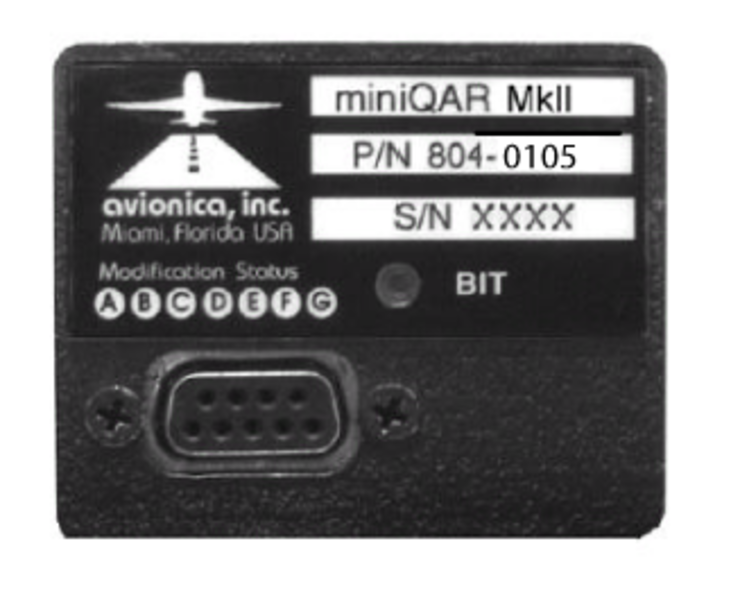
10/26/16
Maintenance Information Points
When the QAR memory is full, the unit stops recording and the LED on the front face blinks. At this point, the QAR requires downloading and the stored data must be erased before it will record again.
It is good practice to periodically perform the download and erase the memory per the AMM tasks (e.g. 500 flight hours or per flight data monitoring requirements) to ensure that the QAR is always recording data.