


05/02/16
Overview
The standby artificial horizon system supplies the flight crew with displays of aircraft attitude, and slip and skid information. The standby artificial horizon system is an alternative to the electronic flight control system (EFIS), or to make sure that the operation of the EFIS is correct.
05/10/16
Standby Artificial Horizon Indicator
The standby instrument system on aircraft serial numbers 9002 through 9157 consists of a standby compass and electromechanical standby attitude and standby altitude/airspeed instruments.
The standby artificial horizon indicator is installed in the center instrument panel.
The standby artificial horizon indicator is an electronically-operated vertical gyroscope. The gyroscope holds a vertical position through the use of a mechanical erection system which has an erection rate of 2.5 degrees for each minute. The erection system automatically stops operation when it gets an acceleration in the longitudinal axis which is greater than approximately 0.16 gram-force. The gyroscope is mechanically connected to the drum to show attitude information.The drum shows the aircraft pitch from -80 to +80 degrees in increments of 5 degrees. The roll index and pointer show the aircraft roll from 90 degrees left to 90 degrees right in increments of 10, 20, 30, 60 and 90 degrees.
The standby artificial horizon indicator presents aircraft attitude information and provides an inclinometer for slip/skid indication. The indicator has a power warning circuit to monitor the voltage applied to the gyro motor, the gyro speed and the caging condition. The inverter circuit in the standby indicator changes the 28 VDC input to 22 VAC, 400 HZ, 3 phase power to operate the gyroscope motor. The power warning circuit monitors the 28 VDC input signal. The failure flag is shown for approximately two minutes when the indicator is first energized, and then goes out of view. The power warning (OFF) flag rotates into view when one of the following conditions occur:
- Loss of 28 VDC input power
- No voltage to the gyro motor
- Gyroscope wheel speed is less than 18,000 rpm
- Caging knob is in the caged position
When the cage knob is pulled and held temporarily, the gyroscope gimbals are put in a position that is related to the case. The gyroscope spin axis is put in a position which is plus or minus one degree of the vertical in pitch and roll. The gimbals are locked in the caged position when the cage knob is pulled. The gimbals are released when the cage knob is released carefully to the usual position.
Note:
Do not suddenly move, turn, or release the cage knob. Sudden movements of the knob can cause damage to the indicator.
After complete power loss, the standby artificial horizon provides reliable attitude information for at least 9 minutes. A slip/skid inclinometer is located at the bottom of the standby attitude indicator. It is capable of indicating at least 10 degrees of roll in each direction.
Standby Artificial Horizon Controls and Indicators
| ITEM | FUNCTION |
|---|---|
| Ball Level Indicator | Shows aircraft slip and skid information |
| Aircraft Symbol | shows the pitch and roll of the aircraft in relation to the horizon. |
| Drum | Connected to the spin motor to give a direct indication of aircraft pitch and roll movement. The brown area shows when the aircraft nose is below the horizon and the blue area shows when the aircraft nose is above the horizon. |
| Roll Pointer | Shows the vertical in any roll attitude. |
| Roll Index | Turns with the aircraft to show the degree of difference between the roll of the aircraft and the roll pointer. |
| Failure Flag | Flag shows for a loss of 28 VDC supply, or the gyroscope wheel speed is less than 18,000 rpm. |
| Horizon Line | Shows the earth’s horizon in relation to the pitch of the aircraft. |
| Cage Knob | Manual control to cage the gyroscope quickly or to lock the gimbals of the gyroscope. |
The BATT MASTER switch on the ELECTRICAL control panel controls the dc power from the Avionics-Battery Direct Bus to the Standby Artificial Horizon Indicator. BATT MASTER switch must be OFF to prevent battery power loss when system is not in use.

Integrated Electronic Standby Instrument
On aircraft serial numbers 9158 and subsequent numbers, the system consists of a standby compass and an integrated electronic standby instrument (IESI).
The IESI is a self-contained unit installed on the instrument panel between the EICAS monitors. The IESI displays artificial horizon, altimeter and airspeed information on a liquid crystal display screen.
The IESI is a display instrument and it comprises the following:
- An active matrix liquid crystal flat panel screen
- Four push-buttons providing for:
- Caging the virtual platform "CAGE"
- Resetting the baro pressure to the standard value (1,013.25 hPa or 29.92 in Hg) "STD"
- Adjusting the brightness of the display "+"
- Adjusting the brightness of the display "−"
- A rotary knob (to adjust barometric correction)
- Inertial sensors and pressure sensors
The equipment is intended to provide "standby" display for the following parameters:
- Attitude
- Metric altitude digital readout
- Standard or baro-corrected altitude and the associated barometric pressure
- Airspeed
Optional Functions Pin Programming allows for the display of the following parameters:
- Heading (not selected)
- Barometric pressure in hPa and / or in Hg (selected for both hPa and in Hg)
- ILS localizer and Glideslope deviation (selected)
Aircraft Configuration Pin Programming allows for the adaptation of the following functions:
- Static Source Error Correction (SSEC) laws
- VMO laws
- Panel Tilt Angle required compensation (18 degrees)

05/02/16
Standby Artificial Horizon CB/Relay Panel
On A/C 9105 and subs, and Post SB 700-34-022 for Global Express, or on A/C 9127 to 9157 for Global 5000
The CB/Relay panel is installed at FS251.25, WL57.78, RBL13.81 on Global Express and at FS251.25+32.00, WL57.78, RBL13.81 on Global 5000, just forward of DCPC, and is attached to the bulkhead with four screws. The avionics battery through the DCPC Avionics-Battery Direct Bus supplies 28 VDC to the standby artificial horizon indicator (standby ADI). It contains a thermal circuit breaker identified as STBY ADI is installed on the CCBP for this power supply. This thermal circuit breaker on the CCBP is monitored on the EMS CDU as STBY ADI.
You must set the BATT MASTER switch on the ELECTRICAL control panel to ON to energize the standby horizon circuit. The BATT MASTER switch controls a standby artificial horizon (ADI) CB/RELAY panel (AP77) installed near the DCPC. There is also another thermal circuit breaker on the CB/RELAY panel identified as STBY ADI which must also be closed to energize the standby ADI. This circuit breaker is also monitored on the EMS CDU as STBY ADI. This circuit breaker is used to isolate the Avionics Direct Bus from the standby horizon system.


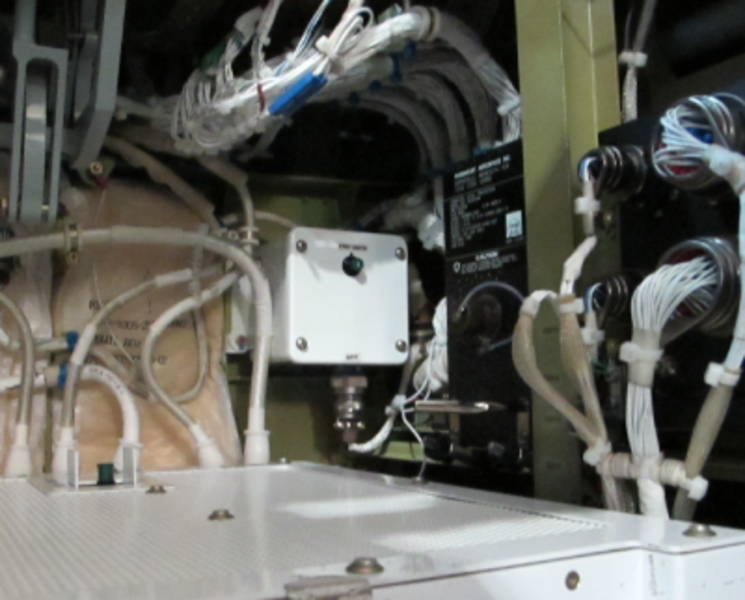
STANDBY ARTIFICIAL HORIZON CB/RELAY PANEL
Integrated Standby Instrument System
The integrated standby instrument system consists of a self-contained integrated standby instrument (IESI).
The IESI is installed to provide standby attitude, altitude and airspeed information to the flight crew. It is used as an alternative source of flight and navigation data.
Integrated Standby Instrument Unit
The integrated electronic standby instrument (IESI) unit is a self-contained LCD display unit that includes pressure sensors, inertial/electronic components and the bezel containing the control pushbuttons.
The IESI is located in the center of the main instrument panel, between the EICAS displays (DUs 3 and 4). The IESI unit is clamp-installed in the IESI mount which attaches to the main instrument panel with four captive screws. On the rear side, the IESI has one electrical connector and two pressure ports (quick-disconnect type).


System Operation
The internal IESI pressure sensors, integrated gyro/ accelerometers and optical components provide the following functions:
- Attitude with a slip-skid indication
- Altitude in feet and in meters display (requires an input from the pitot-static system)
- Airspeed display with VMO/MMO indications and Mach number (requires an input from the pitot-static system as well as slat/flap and AOA information from the stall protection computer)
- LOC/GS indication and deviation and metric altitude selection (requires an input from the IAC 3). LOC/GS deviation indicators are removed when ILS not tuned
- Static source error correction (SSEC)
- Baro pressure in hectopascals (hPa) and inches of mercury (inHg)
The IESI receives 28 VDC electrical power from the avionics battery direct bus.
Dimming control 0-28 VDC used with the pilot lighting control panel and 0-5 VAC used with the bezel lighting.
Control and Indication
Upon power-up, the IESI will first display a 10-second self-test page followed by a 70-second aligning page. After 90 seconds, the IESI will display an operational page.
The following describes button function and display information. The bezel has one rotary switch (BARO) and five pushbuttons: STD, BRT/ DIM (+ and –) and CAGE to control IESI operation.
BARO
The rotary BARO knob allows for barometric altimeter adjustment.
STD
The standard (STD) pushbutton switches the altimeter display from standard pressure to barometric (BARO) pressure.
BRT
The brightness (BRT) control buttons + and – provide adjustment independent of the instrument panel lighting.
CAGE
The cage button resets the attitude to zero when depressed for more than 2 seconds.

05/02/16
System Interface
The standby artificial-horizon system interfaces to the systems that follow:
Secondary-Power Distribution Assembly (SPDA) 1 (On A/C Pre SB 700-34-022 for Global Express)
The Battery Bus through the SPDA 1 supplies 28 VDC to the standby artificial-horizon indicator.
DC Power Center (DCPC) Avionics-Battery Direct Bus (On A/C 9105 and subs, and Post SB 700-34-022 for Global Express, or on A/C 9127 to 9157 for Global 5000)
The avionics battery through the DCPC Avionics Battery Direct Bus supplies 28 VDC to the standby artificial horizon indicator (standby ADI). A thermal circuit breaker identified as STBY ADI is installed on the CCBP for this power supply. This thermal circuit breaker on the CCBP is monitored on the EMS CDU as STBY ADI.
Integral Lighting System
The integral lighting system supplies 5 VDC to the integral lights in the indicator.

On A/C 9105 and Subs, and Post SB 700-34-022 for Global Express, or on A/C 9127 to 9157 for Global 5000
System Monitoring
Power-On Built-In Test
Self-initiated test sequence starts 10 seconds after power-up. During that period the maintenance page is in view. If the test is successful, the IESI CHECK: OK is displayed on the maintenance page, and if it fails, the IESI CHECK: FAIL is displayed with a fault code.
Continuous Built-In Test
During continuous built-in test (CBIT), failures are indicated as follows:
An attitude failure is represented by the removal of the blue and brown background, pitch and roll scales and an attitude red X is displayed to annunciate the failure to the pilot.
The LOC and G/S scales and pointers are removed and replaced with amber X’s to indicate failures. If both LOC and G/S have failed, an amber ILS flag is also displayed.
A yellow static source error correction (SSEC) flag may be displayed if the IESI is not able to compute A/C airspeed and altitude by taking into account SSEC law correction tables.
