

07/06/21
Message Overview:
Message Name:
ENGINE TEMPERATURE IS TOO HIGH AT HIGH POWER
| Message Code: | 771OBS001 |
| Effectivity: | All |
| System: | Power |
| System Description: | 77-10-00 |
| Schematic Diagram: | None |
| Wiring Diagram: | None |
Message Description:
The Engine operating temperature is more than the permitted limits. During engine operation the engine operating temperature is continuously monitored by the Full-Authority Digital Engine-Controller (FADEC).
Possible Causes:
- Oil Pressure Filter Element
- Magnetic Chip-Detector
- Power Plant
Troubleshooting Tips:
Advisory Wire/Service Bulletin: None
Forum Articles/Infoservice/Newsletter: None
Quick Links:
| Engine Safety Precautions | AMM 71-00-00-910-801 [ Global Express ] [ G5000 ] [ Global XRS ] |
| Dry Motor the Engine | AMM 71-00-00-866-804 [ Global Express ] [ G5000 ] [ Global XRS ] |
| Start the Engine | AMM 71-00-00-866-806 [ Global Express ] [ G5000 ] [ Global XRS ] |
| Operation Limits | AMM 71-00-00-866-807 [ Global Express ] [ G5000 ] [ Global XRS ] |
| Engine Shutdown (Usual) | AMM 71-00-00-866-809 [ Global Express ] [ G5000 ] [ Global XRS ] |
| Removal of the Power Plant | AMM 71-00-00-000-801 [ Global Express ] [ G5000 ] [ Global XRS ] |
| Installation of the Power Plant | AMM 71-00-00-400-801 [ Global Express ] [ G5000 ] [ Global XRS ] |
| Opening of the Cowls | AMM 71-10-00-010-801 [ Global Express ] [ G5000 ] [ Global XRS ] |
| Closing of the Cowls | AMM 71-10-00-410-801 [ Global Express ] [ G5000 ] [ Global XRS ] |
| Special Detailed Inspection of the Combustion-liner |
AMM 72-40-00-220-801 [ Global Express ] [ G5000 ] [ Global XRS ] |
| Special Detailed Inspection of the HP Turbine Blades |
AMM 72-40-00-220-802 [ Global Express ] [ G5000 ] [ Global XRS ] |
| Special Detailed Inspection of the HP Turbine Stage-1 Nozzle Guide-Vanes |
AMM 72-40-00-220-803 [ Global Express ] [ G5000 ] [ Global XRS ] |
| General Visual Inspection of the Exhaust Nozzle | AMM 78-10-01-210-801 [ Global Express ] [ G5000 ] [ Global XRS ] |
| General Visual Inspection of the Exhaust Cone | AMM 78-10-02-210-801 [ Global Express ] [ G5000 ] [ Global XRS ] |
| Thrust Reverser Safety Precautions | AMM 78-30-00-910-801 [ Global Express ] [ G5000 ] [ Global XRS ] |
| Deactivation of the Thrust Reverser (for Maintenance) |
AMM 78-30-00-040-801 [ Global Express ] [ G5000 ] [ Global XRS ] |
| Activation of the Thrust Reverser (for Maintenance) |
AMM 78-30-00-440-801 [ Global Express ] [ G5000 ] [ Global XRS ] |
| General Visual Inspection of the Thrust Reverser | AMM 78-30-00-210-801 [ Global Express ] [ G5000 ] [ Global XRS ] |
| Detailed Inspection of the Front-Bearing-Chamber Magnetic Chip-Detector |
AMM 79-21-04-220-801 [ Global Express ] [ G5000 ] [ Global XRS ] |
| Detailed Inspection of the Rear-Bearing-Chamber Magnetic Chip-Detector |
AMM 79-21-04-220-802 [ Global Express ] [ G5000 ] [ Global XRS ] |
| Detailed Inspection of the Accessory-Gearbox Magnetic Chip-Detector |
AMM 79-21-04-220-803 [ Global Express ] [ G5000 ] [ Global XRS ] |
Troubleshooting Recommendations:
- Perform the fault isolation for the engine overtemperature condition at high power. On the EICAS display system get access to the engine exceedance profile maintenance pages. Record the exceedance profile for engine overtemperature as follows:
- The maximum temperature
- The quantity of time that the temperature was more than the limit
- If the overtemperature was stable or not
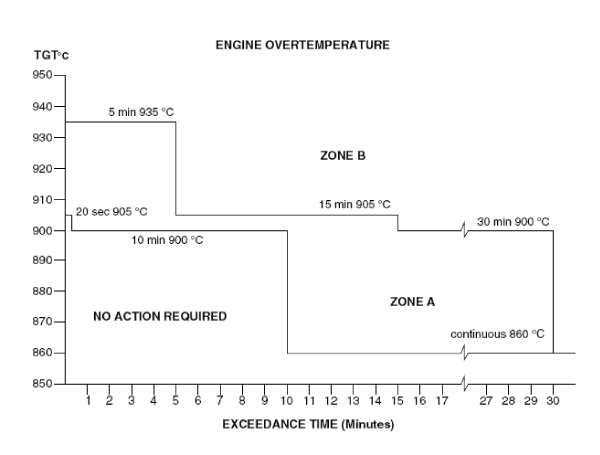
- Use the exceedance profile data above and the recorded engine history to find the total time that the engine was operated at more than 905 °C.
NOTE: This time must include the time for this overtemperature incident and the time for overtemperature incidents which occurred before.- If the engine was operated for a total of 5 minutes or more above 905 °C, go to step 20.
- If the engine was not operated for a total of 5 minutes or more above 905 °C, continue with next step.
- Use the exceedance profile data above and the engine overtemperature at high power graph to find out if the overtemperature was in Zone A or Zone B.
- Check if the overtemperature is in Zone A or Zone B.
- If the engine overtemperature is in Zone B, go to step 20.
- If the overtemperature is in Zone A (Figure 1), continue with next step.
- Examine the exhaust nozzle, exhaust cone and thrust reverser.
- If fault remains, repair as required and continue with next step.
- If system checks are good, continue with next step.
- Visually examine the stage 2 LP turbine blades.
- If fault remains, repair as required and continue with next step.
- If system checks are good, continue with next step.
- Examine the oil pressure filter element for metal or carbon contamination. Make an analysis of an oil sample for acidity and free carbon content.
- If there is contamination, replace oil pressure filter element and do close out.
- If there is no contamination, continue with next step.
- Examine the magnetic chip-detectors for contamination.
- If there is contamination, replace magnetic chip-detector and do close out.
- If there is no contamination, continue with next step.
- Perform the detailed inspection of the front-bearing-chamber magnetic chip-detector.
- If damage or defect is found, rectify or repair as required and do close out.
- If no damage or defect is found, continue with next step.
- Perform the detailed inspection of the rear-bearing-chamber magnetic chip-detector.
- If damage or defect is found, rectify or repair as required and do close out.
- If no damage or defect is found, continue with next step.
- Perform the detailed inspection of the accessory-gearbox magnetic chip-detector.
CAUTION: DO NOT USE A TOOL WITH A SHARP EDGE TO TURN THE LP ROTOR. TOOLS WITH SHARP EDGES CAN CAUSE DAMAGE TO THE LP COMPRESSOR BLADES.- If damage or defect is found, rectify or repair as required and do close out.
- If no damage or defect is found, continue with next step.
- Make sure that the LP rotor can turn freely in a counterclockwise direction (when you look from the front of the engine) without unusual noises.
- If it does not turn freely or there are unusual noises, do not use force to turn the LP rotor. There is possibly internal damage, go to step 20.
- If it does turn freely or there are no unusual noises, continue with next step.
- Make sure that the HP rotor can turn freely in a counterclockwise direction (when you look from the front of the engine) without unusual noises.
- If it does not turn freely or there are unusual noises, do not use force to turn the HP rotor. There is possibly internal damage, go to step 20.
- If it does turn freely or there are no unusual noises, continue with next step.
- Dry motor the engine. If you hear unusual noises, go to step 20.
- Examine the combustion-liner, combustion section, LP turbine, HP turbine blades, HP turbine stage-1 nozzle guide-vanes.
- If fault remains, repair as required and do close out.
- If system checks are good, continue with next step.
- Perform an engine ground run.
- Stop the engine.
- Monitor the engine run down time from ground idle.
- On the upper left HP compressor fairing, examine the seat in the HP8 bleed-valve cover for signs of overheating.
- If the above checks and inspections are satisfactory, put the engine back to usual operation.
- If the above checks and inspections are not satisfactory, refer to your Rolls-Royce representative.
- Replace power plant.
- Do close out.